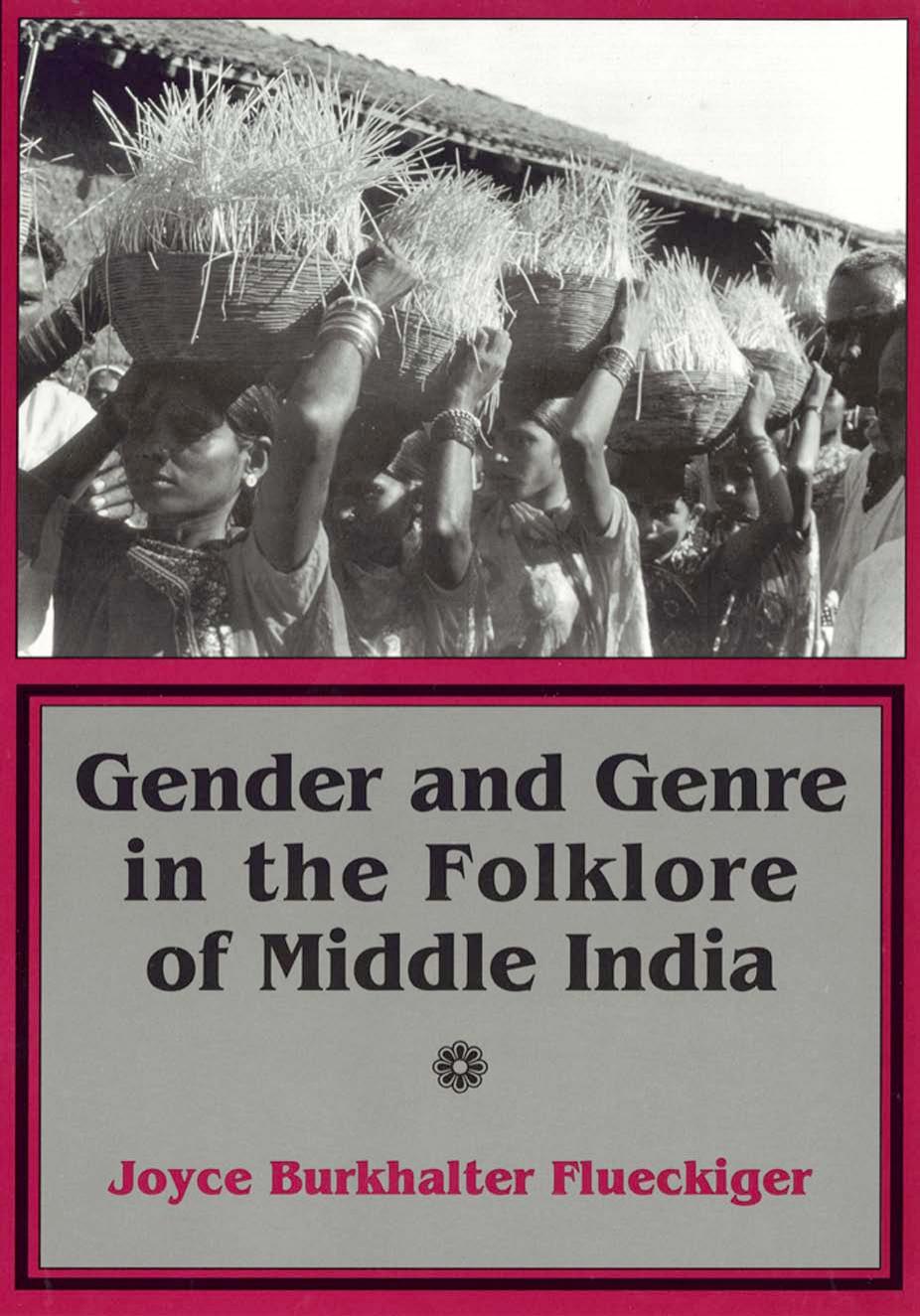
Gender and Genre in the Folklore of Middle India by Joyce Burkhalter Flueckiger
Author:Joyce Burkhalter Flueckiger
Language: eng
Format: epub, pdf
Publisher: Cornell University Press
Published: 2018-10-31T16:00:00+00:00
The performance context of the nācā is important in establishing the epic s regional character. Troupes are usually multicaste, heavily represented by Satnamis but also by other middle-level castes, including Rauts; one performance troupe I met consisted of ten members from six different castes. Troupes are hired by village/neighborhood councils for annual village fairs or festivals, particularly durgā pūjā and gaṇés caturthī,23 or as independent entertainment events. Occasionally, a family will sponsor a performance to celebrate the birth of a son or a wedding.
Nācā audiences, too, represent the caste spectrum of a particular village or urban neighborhood, male and female. Nācā are performed in public space such as a village or town square or main street, accessible to everyone. Persons from surrounding villages frequently walk several miles to attend nācā in neighboring villages. The enthusiastic and responsive participation of women in the primary audience of the candainī nācā stands in sharp contrast to the all-male audiences and performance contexts of the U.P. variants of the epic. In 1980 when I asked female audience members if women ever sang candainī in Chhattisgarh, they all answered negatively. I did hear segments of the epic narrative and reference to its characters in other female performance genres, which they did not, however, identify as “candainī,” because of the performance context and singing style. To sing “candainī” means to sing in a public context and, more specifically, to incorporate at some level the responsive singing style of the candainī rāgī, with his end-of-line words of tor or mor. What these women were singing was identified by context and rāg (melodic structure) as a harvest-dance song (suā nāc) rather than by content as candainī.
In recent years, a handful of individual female performers have performed the gīt style of candainī professionally, accompanied by male rāgī and musicians. They are self-taught and have gained meteoric popularity because of their unusual position as professional, public female performers. Several audience members told me, “Who wouldn’t go to hear a woman? There’s more entertainment in that!” One such female performer is Suraj Bai, who, in 1987, was hailed in a local English-language newspaper as “the melody queen.” She had represented Chhattisgarh at national and state folk festivals and had performed on nationwide television and radio; yet, the newspaper article bemoaned, she still worked as a day laborer. Over the last five years in Chhattisgarh, the epic tradition of paṇḍvānī is experiencing a similar rise in popularity, attributable primarily to the fact that the tradition is being performed by two professional female singers, Tijan Bai and Ritu Varma, who have gained notoriety through their performances on television and radio.
Although candainī female performers are still unusual, the worldview expressed by both female and male performers of the Chhattisgarhi epic is a female-centered one.24 The heroine Candaini is the dominant character in the pair of lovers and the initiator of most of the epic action. In fact, in several episodes she actually saves or protects Lorik, a reversal of the situation in the U.P. variants.
Download
Gender and Genre in the Folklore of Middle India by Joyce Burkhalter Flueckiger.pdf
This site does not store any files on its server. We only index and link to content provided by other sites. Please contact the content providers to delete copyright contents if any and email us, we'll remove relevant links or contents immediately.
4 3 2 1: A Novel by Paul Auster(12405)
The handmaid's tale by Margaret Atwood(7773)
Giovanni's Room by James Baldwin(7354)
Big Magic: Creative Living Beyond Fear by Elizabeth Gilbert(5780)
Asking the Right Questions: A Guide to Critical Thinking by M. Neil Browne & Stuart M. Keeley(5779)
Ego Is the Enemy by Ryan Holiday(5455)
The Body: A Guide for Occupants by Bill Bryson(5103)
On Writing A Memoir of the Craft by Stephen King(4948)
Ken Follett - World without end by Ken Follett(4740)
Adulting by Kelly Williams Brown(4582)
Bluets by Maggie Nelson(4565)
Eat That Frog! by Brian Tracy(4546)
Guilty Pleasures by Laurell K Hamilton(4455)
The Poetry of Pablo Neruda by Pablo Neruda(4113)
Alive: The Story of the Andes Survivors by Piers Paul Read(4037)
White Noise - A Novel by Don DeLillo(4018)
Fingerprints of the Gods by Graham Hancock(4009)
The Book of Joy by Dalai Lama(3996)
The Bookshop by Penelope Fitzgerald(3857)
